 ADAM PULSE
Building a Security Foundation Across Your Organization
The short answer: Give the work that protects money, access and sensitive information a named owner, a backup, a concrete action and proof of completion. Verify sensitive requests through records you already hold, put technical controls behind that process, give AI tools and agents defined boundaries, and practice the handoffs until they work. Start with the people and systems you actually have.
A person receives an urgent request that looks legitimate. They hesitate. What happens next depends on more than the firewall: can they pause the request, do they know whom to contact, and will somebody take responsibility when they report it?
That is the foundation this guide helps you build. It is written for owners, managers, employees, IT providers and vendors, because each of them holds part of it.
Why the transportation analogy works
In 2023 remarks to the Maryland Cybersecurity Council, former US National Cyber Director Chris Inglis used automobile safety to explain shared cybersecurity responsibility. Manufacturers and motorists have different duties within the same safety system. The useful lesson for a business is that protection depends on coordinated responsibilities.
Your organization can apply that principle without turning every employee into a security analyst. Employees need clear rules for their work. Technical teams need the authority and resources to maintain the controls. Leadership must fund the work and follow the same verification rules as everyone else.
Assign responsibilities to real people
| Role | Primary responsibility |
|---|---|
| Owner or executive sponsor | Own business risk, fund controls and authorize people to pause sensitive work. |
| Finance and operations | Verify payment and supplier changes, enforce approvals and preserve records. |
| Managers and HR | Trigger access changes when people join, change roles or leave. |
| Every employee | Use approved systems, pause sensitive requests and report concerns promptly. |
| IT provider or security lead | Protect identities and systems, receive reports and coordinate technical response. |
| Vendors and application owners | Deliver agreed safeguards, support access removal and clarify incident duties. |
One person may hold several roles. Record names and backups, and preserve independent approval for sensitive transactions.
Roles and accountability are explicit outcomes in the NIST Cybersecurity Framework (CSF) 2.0. Under its GV.RR category, organizational leadership is responsible and accountable for cybersecurity risk (GV.RR-01), and roles, responsibilities and authorities are established, communicated, understood and enforced (GV.RR-02).
Verify sensitive requests before acting
AI can make an impersonation more convincing. The FBI has warned that criminals use AI-generated text, images, audio and video to support fraud. Employees should not have to judge whether a voice sounds artificial before they follow a verification rule.
Define the requests that require a pause
Recommended triggers include new or changed bank details, unusual payment requests, payroll changes, password or MFA resets, new administrative access, sensitive data exports and requests to bypass normal approvals. Apply the rule even when the request appears to come from the owner.
Use a repeatable verification sequence
- Pause the action. Keep the payment, access change or data release on hold while verification is incomplete.
- Initiate independent contact. Use a number from an established directory or supplier record. Do not use a number, link or replacement contact supplied in the request.
- Confirm the specific action. Verify the destination, amount, access scope or data involved. Recognizing the person does not establish that the transaction is authorized.
- Obtain the required approval. Set approval thresholds in advance. Require independent review for bank detail changes and other especially sensitive actions. The requester must not also provide the independent approval.
- Record the outcome. Keep the verification method, approver, time and decision in the appropriate business system. If verification fails, keep the action on hold and escalate.
FBI guidance on business email compromise says to verify requests for changes in account information with the intended recipient, through a secondary channel or two-factor authentication. The approval structure above is a proposed business control, to be configured for your organization.
Where a corporate safe word fits
The FBI suggests that families create a secret word or phrase to verify each other's identity. That is family guidance, not an enterprise authentication standard. A corporate phrase can be an extra signal, but a correct answer should never release a payment or bypass an access approval.
A shared secret can leak through chat, email, social engineering or a compromised account. Personal trivia can also become known. Do not make either one the foundation of your process. Never ask someone to disclose login codes or recovery codes as an identity check.
If you use a phrase, define who may know it, how it is stored and how to replace it after suspected exposure. Do not record the secret itself in the verification log. When a trusted contact cannot be reached, use the documented backup. Urgency does not create permission.
Give employees usable language
"Before I process this, I need to complete our verification and approval steps. I will contact you using the details in our records."
Put technical protection behind the process
People need systems that support the rules. Agree in writing which controls your internal team, IT provider and application vendors maintain. A contract that says "IT support" is too vague to establish who reviews alerts or restores a failed service.
Protect identity and manage access
Require multi-factor authentication (MFA) for supported business systems. For privileged and sensitive accounts, prioritize phishing-resistant methods. NIST's small business guidance notes that one-time PINs and SMS codes can be phished, and identifies FIDO authenticators that use the W3C Web Authentication standard, either hardware security keys or authenticators built into a phone or laptop, as the most common phishing-resistant option. The FIDO Alliance describes passkeys as credentials built on the same FIDO standards.
Confirm coverage, recovery procedures and exceptions. MFA reduces risk. It does not authorize a payment or eliminate every form of account compromise.
HR or the manager should initiate access changes through a recorded request. IT implements the change, and the manager verifies that access matches the person's role. Departures should cover sessions, recovery methods, devices and connected applications, not just the primary mailbox.
Maintain systems and know what is exposed
Keep an inventory of business systems, devices, administrators and critical suppliers. Assign patching and configuration ownership. Prioritize remediation based on exposure, exploitation and business impact, and document each exception with an owner, compensating controls and a review date.
Use restricted administrative accounts and limit access to what each role needs. Network segmentation can limit the spread of an intrusion, but it is one control within a broader architecture. NIST's zero trust architecture (SP 800-207) grants no implicit trust to a device or account based solely on its network location or on who owns it.
Make monitoring an owned service
Agree which identity, email, endpoint and administrative events are collected, how long records are retained and who investigates. Specify business-hours and after-hours coverage, acknowledgement expectations, escalation contacts and the backup when the primary owner is unavailable. Let alert urgency drive response. A weekly review alone is not enough for an active compromise.
Test the reporting route with an authorized sample report. The evidence should show receipt, acknowledgement, a named responder and a recorded next action. A ticket that exists without an owner has not completed the handoff.
Protect email and prove recovery
Have IT validate SPF and DKIM for legitimate senders, then introduce DMARC enforcement gradually, after monitoring shows that legitimate mail is authenticating correctly. DMARC, now defined in RFC 9989, helps defend against unauthorized use of your domain. A DMARC pass shows only that the sender was authorized to use the domain, not that the message is safe. It does not stop lookalike domains or display-name impersonation, and it cannot catch mail sent from a compromised legitimate account.
Identify the services the business must recover first. Assign backups, protect them against deletion or alteration, and test a representative restore. Record what was restored, how long it took and whether the business owner could use it. A successful backup job is useful evidence, but it is not a recovery test.
Give AI tools and agents defined boundaries
AI creates two distinct responsibilities: protecting people against AI-assisted deception, and controlling the AI systems your own organization uses. Both belong in the same operating foundation.
Make approved use easy to understand
Maintain an inventory of AI tools, including free services, browser extensions and applications with built-in AI features. Record the business owner, purpose, data handled, connected systems and approval status. Make it easy for employees to disclose existing use so the team can assess it.
For each approved use, explain which data is allowed, which is prohibited and who can approve an exception. Approval should depend on the particular service, configuration, contract and data involved. An approved product name does not authorize every feature or every use of customer information.
Before allowing sensitive data, review access, retention, training use, sharing and deletion settings with the responsible owner. When a proposed use cannot be approved, give staff a practical route to an approved tool or a redacted workflow.
Treat agents as identities with permissions
An agent that can read documents, send messages or change records needs explicit limits. Give it a dedicated identity where supported and only the permissions its task requires. Document who owns it and who can disable it.
Instructions hidden in emails, documents or web pages can attempt to redirect an AI system. This is prompt injection. The UK National Cyber Security Centre (NCSC) warns that current large language models do not enforce a security boundary between instructions and data. Treat external content as untrusted input, and enforce restrictions through permissions and application controls rather than relying on a prompt alone.
For consequential actions, require approval of the specific proposed action before it runs. Log what the agent attempted, what it changed and who approved it. Keep a tested way to stop the agent and revoke its access. NCSC guidance on agentic AI recommends keeping agent autonomy proportionate to the organization's risk appetite, a unique identity and only the permissions needed for each agent, observability, and the ability to halt agent activity immediately.
Make the handoff explicit
| Trigger | Who acts next | Evidence |
|---|---|---|
| Employee requests a new AI tool | Business owner and IT assess data and access | Approval record with scope and restrictions |
| Agent proposes sensitive data sharing | Authorized data owner reviews the actual recipient and content | Decision linked to the proposed action |
| Unexpected agent action occurs | IT stops access; business owner assesses impact | Action log, containment record and follow-up owner |
A blocked workflow should tell the employee what to do next. If the only instruction is "do not use AI," people still have the original business task and no supported way to complete it.
Practice the handoffs and improve the system
Use this starting approach to put responsibilities into practice. Adjust it to business risk, staffing and existing obligations, then test it against the work your teams actually perform.
Begin with a short working session
Bring the owner, finance lead, operations or HR manager and IT provider together. Identify the most consequential actions in the business, name an owner and backup for each, and agree who may pause them. Resolve gaps before distributing the checklist.
Publish one maintained reference with the reporting route, backup contact, verification triggers, approval rules and emergency escalation instructions. Keep an accessible copy outside the systems that could be unavailable during an incident. Share it with new hires and relevant vendors.
Run an illustrative exercise
A message appearing to come from the owner asks finance to change a supplier's bank details and release payment immediately. A convincing voice call follows. The supposed owner says there is no time for the normal process.
- Finance pauses the change and obtains the supplier contact from the existing record.
- The independent check fails. Finance preserves the request and reports it through the established channel.
- The responder acknowledges ownership, checks for related account compromise and records the next action.
- The business owner confirms whether money or data moved. If funds were sent, finance contacts the financial institution immediately to request a recall, and the incident is reported to the FBI's Internet Crime Complaint Center at ic3.gov. IT and the incident lead proceed with containment.
- The team reviews the record and fixes the unclear contact, approval or handoff the exercise exposed.
Measure whether the process works
Suggested evidence includes the share of sensitive transactions with recorded verification, time from report to acknowledgement, access changes completed by the agreed deadline, tested restores and unresolved control gaps. Establish your own baseline before choosing targets. Training attendance alone does not show that a person can complete a verification or a report.
Run a short exercise after material workflow changes and on a regular schedule. For a starting cadence, consider a quarterly contact and ownership review and a twice-yearly scenario exercise. These are proposed operating intervals, not universal standards.
Support reporting and preserve accountability
Thank people for reporting concerns and honest mistakes promptly. Investigate what happened, provide coaching and address intentional misconduct through established HR policy. Reporting should not itself trigger punishment. The aim is early visibility and correction, with fair accountability for conduct.
Leadership makes this credible by accepting verification when the request is their own. Every employee should know the next step, and the person receiving the report should know that the next step belongs to them.
Foundational security checklist
Use this as a working review. For each item, record a named owner, backup, status, evidence link and next review date. An unchecked or unknown item needs an action owner and a due date. Do not mark an item complete on verbal assurance alone.
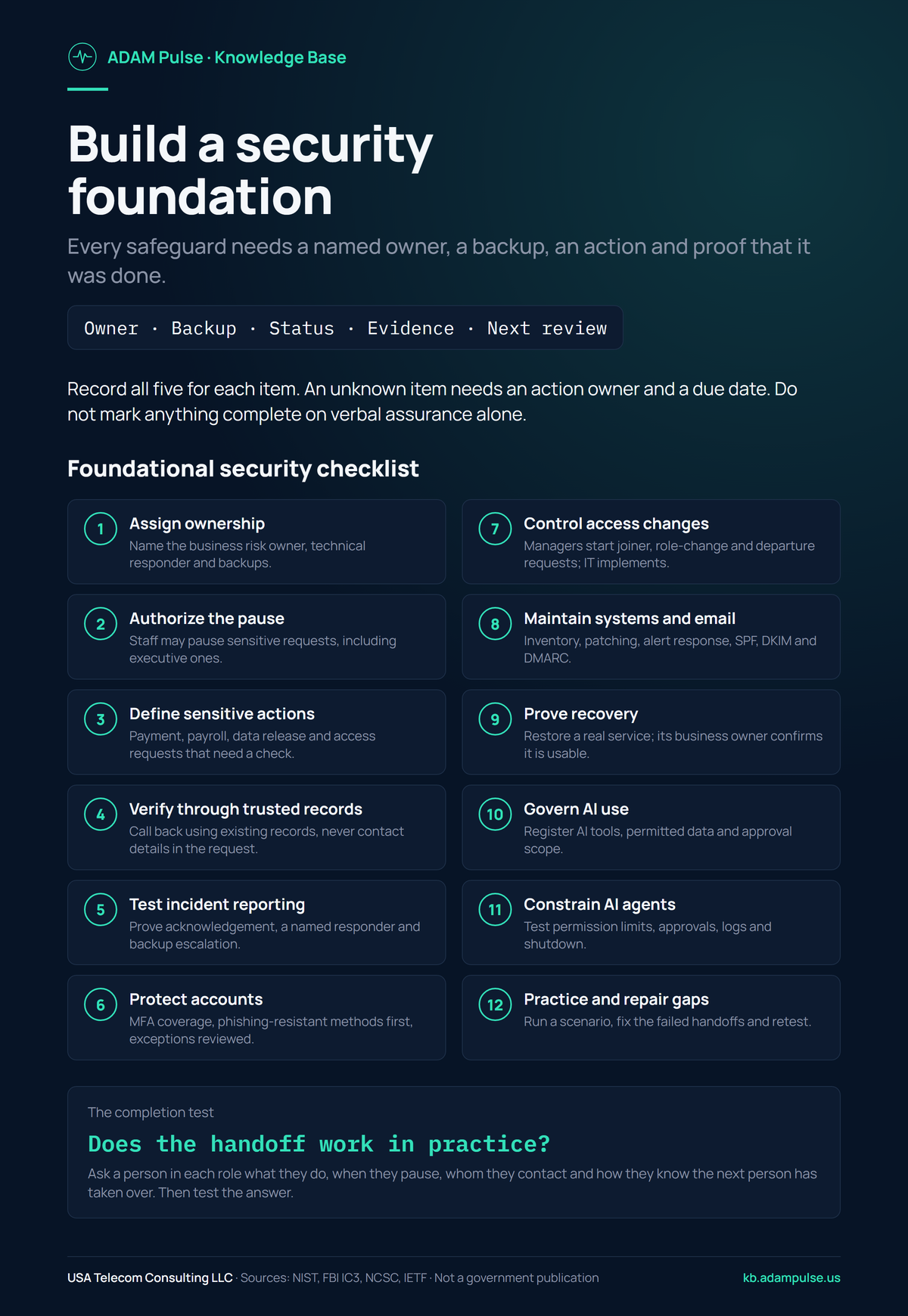
| Checkpoint | Who does what | Evidence |
|---|---|---|
| 1. Assign ownership | Leadership names the business risk owner, technical responder and backups. | Current responsibility and escalation list. |
| 2. Authorize the pause | Leadership confirms that staff may pause sensitive requests, including executive requests, while verification is incomplete. | Communicated rule and exercise result. |
| 3. Define sensitive actions | Finance, HR and IT identify requests requiring independent verification and approval. | Payment, payroll, data release and access rules. |
| 4. Verify through trusted records | Finance and operations test independent contact using existing records. | Verification and approval record, without secret values. |
| 5. Test incident reporting | Every team can find the reporting route; IT tests acknowledgement and backup escalation. | Test ticket with a named responder and next action. |
| 6. Protect accounts | IT verifies MFA coverage, prioritizes phishing-resistant methods and reviews exceptions and recovery. | Configuration report and assigned remediation. |
| 7. Control access changes | Managers initiate joiner, role change and departure requests; IT implements them. | Completed requests and access review. |
| 8. Maintain systems and email | IT assigns inventory, patching, alert response and SPF, DKIM and DMARC responsibilities. | Configuration checks, remediation records and delivery tests. |
| 9. Prove recovery | IT restores a representative business service or dataset; its business owner validates usability. | Dated restore result and measured recovery time. |
| 10. Govern AI use | Business owners and IT record AI tools, permitted data and approval scope. | Maintained register and staff guidance. |
| 11. Constrain AI agents | Agent owners test permission limits, sensitive-action approvals, logs and shutdown. | Access review and observed test results. If no agents exist, mark not applicable with a reason. |
| 12. Practice and repair gaps | Leadership runs a scenario across departments and, where relevant, vendors. | Exercise record, failed handoffs, owners, due dates and retest results. |
The completion test
Ask a person in each role to explain what they do, when they pause, whom they contact and how they know the next person has taken over. Then test the answer. The foundation is working when the handoff works in practice.
Frequently asked questions
Should a business use a safe word to verify payment requests?
A corporate phrase can be an extra signal, but a correct answer should never release a payment or bypass an access approval. The FBI suggests a secret word or phrase for families, which is not an enterprise authentication standard. Verify through contact details already in your records and require independent approval.
Does DMARC stop impersonation emails?
Only in part. DMARC helps stop unauthorized use of your own domain. A DMARC pass does not mean a message is safe, and DMARC does not stop lookalike domains, display-name impersonation or mail sent from a compromised legitimate account.
How should an organization control AI agents?
Treat each agent as an identity with permissions. Give it a dedicated identity where supported, only the access its task requires, a named owner, approval before consequential actions, a log of what it did and a tested way to stop it and revoke its access.
Sources and further reading
Primary and institutional sources, checked October 24, 2026.
- University of Maryland Global Campus — Inglis Stresses Doctrine: Getting Cyber Roles and Responsibilities Right (UMGC News, October 25, 2023). Account of Chris Inglis's remarks to the Maryland Cybersecurity Council on automobile safety and shared cybersecurity responsibility.
- NIST — The NIST Cybersecurity Framework (CSF) 2.0, NIST CSWP 29 (February 26, 2024). See GV.RR-01 and GV.RR-02 on leadership accountability, roles and authorities. The framework describes outcomes and does not prescribe this article's workflow.
- FBI Internet Crime Complaint Center — Criminals Use Generative Artificial Intelligence to Facilitate Financial Fraud, Alert I-120324-PSA (December 3, 2024). AI-generated text, images, audio and video in fraud, and a secret word or phrase for families.
- FBI Internet Crime Complaint Center — Business Email Compromise (BEC). Verifying account-change requests through a secondary channel, requesting a recall or reversal, and filing a complaint.
- NIST — Multi-Factor Authentication, Small Business Cybersecurity Corner (updated January 5, 2026). Phishing-resistant authentication and the phishing risk of one-time PINs and SMS codes.
- FIDO Alliance — Passkeys. Passkeys as FIDO-standard, phishing-resistant credentials.
- NIST — Zero Trust Architecture, SP 800-207 (August 2020). Network location or ownership alone does not confer implicit trust.
- IETF — RFC 9989: Domain-Based Message Authentication, Reporting, and Conformance (DMARC) (May 2026; obsoletes RFCs 7489 and 9091). DMARC scope, deployment sequence and limitations.
- M3AAWG — DMARC Technology Summary. Lookalike-domain and display-name limitations.
- UK National Cyber Security Centre — Managing the cyber risk of agentic AI (August 20, 2026). Interim guidance on proportionate autonomy, agent identity, least privilege, observability and emergency shutdown.
- UK National Cyber Security Centre — Prompt injection is not SQL injection (it may be worse) (December 8, 2025). Why language models do not separate instructions from data.
This article is educational guidance from the ADAM Pulse Knowledge Base. Cybersecurity risk and the controls appropriate to it vary by organization. Evaluate these recommendations against your own technology environment, business requirements, regulatory obligations, threat profile and risk tolerance. The proposed workflows, checklist and review intervals are practical recommendations, not a certification or a complete compliance assessment. Sources were checked October 24, 2026.
USA Telecom Consulting LLC runs a 24/7 NOC. We monitor networks, circuits and firewalls for regulated and defense-supply-chain organizations.